Tuesday, October 31, 2006

Haunted Songs for All Hallow's Eve

In a pioneering collaborative cross-post with my music-geek brother over at Pop with a Shotgun, I offer here a selection of songs that have unnerved, unhinged, disjointed, disturbed, and/or flat-out frightened me over the past year and in years past.

Happy Halloween — hope y’all find some sweet candy in your bags, heh-heh.

1. “SHE MOVED THROUGH THE FAIR," artist unknown
Few folk songs have been recorded as often as this one. Folkies love it because it smells of the ancient, while New Agers love it for its affirmation of life after death and love, or at least romance, everlasting. Certainly every musician with a drop of Irish blood has taken the lance to it: versions exist by John McCormack, Elvis Costello, Van Morrison, Sinead O’Connor and The Chieftains, Loreena McKennitt, and so on. The modern lyrics were written by Padraic Colum, poet, novelist, dramatist, and folklorist of Eire, and the tune, by Herbert Hughes, was based on a fiddle air collected in Donegal in 1909; but some form of the song surely dates back to Medieval times and beyond.

Perhaps the best-known version to rock and roll ears — and the style-setter for most later covers — is by Fairport Convention; sung by the late Sandy Denny, it’s on their second album, What We Did on Our Holidays (1969). Denny’s version was based on a precursor by Anne Briggs, and Briggs got it from locally famed Irish banjoist and “traveling singer” Margaret Barry (1917-90). Barry, who had been singing the piece for decades in various long and short versions, can be credited with keeping it alive until modern pop had a chance to discover it. Her sharp, bloody rendition is heard on the Rounder compilation I Sang Through the Fairs, containing songs and memories recorded in discussion with Alan Lomax in 1953.

A bit of web-trawling will reveal any number of versions posted by musicians on the various state-fair and city-jamboree circuits. Few are unlistenable. Listed here is one of the simpler versions I turned up: a single twice-echoing pipe of wood, blowing improvisatory variations on the song’s basic lines. I don’t remember who recorded this, and I can’t rediscover where I found it; but I can hear the piper’s breath draw up sharp and nervous between each long, long phrase. It feels like he’s right here with me. It’s an invocation of the night and whatever might be waiting to come out.

2. “(GHOST) RIDERS IN THE SKY,” The Ramrods
Somewhere out in the American West, as if in response to the Irish pipe, skies darken and apparitions appear.

This song’s author, Stan Jones, grew up on the prairie and recalled the old cowboy’s warning to reckless boys: Look into the sky, and you can see the ghost herd. Be careful out here, or you’ll join it one day. On his 34th birthday, at his home in Death Valley, Jones wrote a song that sounded as old as the ghosts it imagined.

Since then it’s been a favorite of old cowboy stars, nightclub crooners, and garage bands alike, done by Roy Rogers and Spike Jones, Johnny Cash and Peggy Lee, Burl Ives and REM. The Ramrods’ instrumental was the big hit version of the rock era, reaching the Top 30 in February 1961. The snap and beat of the band sound like surf, but the voices that fly over and streak past — whip-snapping cowpokes, a wailing woman — are the sound of that thundering herd, that mythic mass of spirits.

3. “DEVIL GOT MY WOMAN,” Skip James
A small Midwestern town. A man sits on a corner. He plays the guitar, thumps his heel down below for a subtle pulse, and cries high. His cry hangs on the gray afternoon wind for five minutes’ time. He sings about the devil, and about a woman. You know I’d rather be the devil, than to be that woman now. Maybe ten people walk by in those five minutes. One passerby slows, double-takes the shut-eyed singer, stops to listen. Then gets scared, looks at the sky, and hurries on.

By the end of the song, it has turned to night. There’s no sound but the wind and a rusty weathervane turning somewhere above. The man packs up his guitar, walks off, and is never seen again.

Note: I specify the latter-day remake, from the 1968 LP of the same title, over the 1931 Grafton recording.

4. “PHANTOM 309,” Red Sovine
Headlights on the highway, coming around the turn. Sovine, king of the trucker’s ballad, here reverses the legend of the phantom hitchhiker — the wandering ghost, usually a girl, who flags a ride with some unsuspecting motorist in the hope of finding her way home. In Sovine’s version, it’s the hitchhiker-narrator who is the innocent. Down on his luck, he snares a ride with trucker Big Joe, who takes him up the road to a diner and tosses him a dime for coffee. When he tries to cash it in, explaining where he got it, It got deathly quiet . . . and the waiter’s face got kinda white.

Turns out Big Joe took a fatal skid some time back: he twisted his wheel and went to his death rather than collide with a school bus.

5. “SALLY GO 'ROUND THE ROSES,” The Jaynetts
“Spookiest and most exotic of all girl group discs,” Dave Marsh called this, placing it #377th in The Heart of Rock and Soul: The 1001 Greatest Singles Ever Made (1989). Your blogger wouldn’t argue.

The song, Marsh says, “operates as a metaphor, but its message is as murky as week-old gossip. Superficially, Sally’s friends are just warning her against going downtown, because there she’ll find the ‘the saddest thing in the whole wide world,’ her baby with another girl. But the mix and arrangement and the odd metaphor of the endlessly repeated chorus (‘Sally, go ‘round the roses / They won’t tell your secret’) lend the entire production an ominous air, as if some deeper tale waits to be told.

“A quarter century later, after endless spins, it’s no closer to being revealed.”

6. “JOHNNY REMEMBER ME,” John Leyton
The galloping rhythm, the windy echo, the dead girl wailing in the treetops. It’s all Joe Meek: poor mad, brilliant, dead Joe Meek. And it has the power to make you think of Wuthering Heights. Or Goethe’s The Erl-King. Or “Ghost Riders in the Sky.”

I first heard this song on January 21, 2001, at the Walter Reade Theater in New York, while watching a seldom-screened two-part BBC documentary called The Brian Epstein Story. That was a strange, strange night: I met someone who was a ghost, or might as well have been. I’ve got witnesses.

I wrote about it once. To be continued . . .

7. “HOPE THERE'S SOMEONE,” Antony & The Johnsons
If you’re feeling life is too scary to be lived, don’t listen to this. It might convince you you’re right.

8. “DON'T FEAR THE REAPER,” Blüe Oyster Cult
Poison-flavored bubblegum. It’s a joke, some would say not even a good one: “proto-Jehovah’s witness crap,” Marsh called it, “that doesn’t scare (or convince) anybody.” Anybody but me and a few million others. No kid who grew up white, Midwestern, and radio-fixated in the 1970s is without some feeling about this record. You hate it or you love it, or you just shiver when you hear it. It’s like the line from The Usual Suspects: “I don’t believe in God, but I’m scared of him.” I don’t believe in this record, but I’m scared of it.

9. “NAKED IN THE AFTERNOON,” Jandek
Loathsome schizo wanders the impeccable rooms of his suburban Houston home and plots gruesome acts, turns them into twanging, dissonant, tuneless, endless songs. Scares hell out of anyone who has sense enough to not listen to too much of it at once.

10. “WHO DO YOU LOVE,” Ronnie Hawkins
Bo Diddley wrote the lyrics, and they’re lyrics that white would-be badasses like Jim Morrison and George Thorogood have never tired of trying to live up to, earn the right to understand. But what’s to understand? This is the rock and roll graveyard, more vivid than any psychobilly extravagance, subtler than Screamin’ Jay Hawkins, no “Monster Mash” sitcom. This is the Devil coming through. He’s horny, hustling, setting fires, spreading evil.

I walked 47 miles of barbedwire, use a cobrasnake for a necktie
Got a brandnew house by the roadside made from rattlesnake hide
Got a brandnew chimney made on top made from a human skull


Bo Diddley’s original has a haze on it, an aural thickness, an unreality: all that tremelo on his rectangular guitar and cheap amplifier makes the graveyard night fat, soft, surreal, a convocation of Epicurean demons. Ronnie Hawkins, gripped by something — maybe an evil mood, maybe the white would-be badass’s drive to outfrighten the frightener — gets closer to something really raw, really scarred.

I got a tombstone hand and a graveyard mind
I lived long enough and I ain’t scared a dyin’


This is the only record on my list of ghastlies that is sexy and scary both — and probably the only one that wants to be both. That makes it perverse. And that perversity wins Ronnie the right to say he understands, to claim that he has gone all the way there and returned to tell the story, that he reached his hand into the very fires of the deepest pit and will show you the burn.

The night was black and the moon was blue
And down the alley an icewagon flew
Bump was hit lord and somebody screamed
You should a heard just what I seen


This song features one of the great unanswerable non-sequiturs in modern art, up there with I am the Walrus and Mein Feuhrer, I can walk!! And Hawkins does justice to it — to Bo Diddley’s greatest line, his greatest rock and roll idea, an idea that has no right to be scary but nonetheless is:

Who do you love?


11. “LONG LONG LONG,” The Beatles
God, this is so quiet. So, so, so quiet. As a kid I couldn’t hear it: getting my head next to the speaker to hear the words, catch the little noises, was an experiment in fear. Because I knew the song was going to rear up, that it was coming to get me. First in the middle eight, So many years I was searching — one of the simplest and most powerful stretches of music and lyric George Harrison ever wrote — and finally at the climax, when haunted electronics surge upward from the wires and circuits like buried evil at the end of Five Million Years to Earth, and George opens his mouth to release a sound so unearthly, so —

Possibly the scariest song on what is certainly the scariest rock and roll album there is.

12. “BANSHEE,” Henry Cowell
We’ve heard many imitations and apprehensions of the banshee up to now: ghost riders, spirit lovers. Here she speaks for herself in extended shrieks and low drawn-out groans, with composer Henry Cowell as medium. Set amid the futurisms and constructivisms of the 1958 Folkways LP Sounds of New Music — which features such avant-garde curios as Soviet symphonies for power station and steel foundry — this piece of primitive horror protrudes like a gnarled finger. Cowell manually batters and caresses the exposed strings of a grand piano: “By scratching, plucking, pounding and sweeping the strings and taking full advantage of the strings’ sympathetic vibrations,” the liner notes read, “the composer has perfectly evoked the Banshee of Irish and Scottish folklore, the female spirit whose wailings forewarn families of the approaching death of a member.”

13. “VENUS IN FURS,” The Velvet Underground
Me + this song + a dark room = never in a million years.

14. “THE LONG BLACK VEIL,” Lefty Frizzell
The song is a natural ghost story, a piece of commercially canny pop that came out a fully-formed myth: like “Ghost Riders,” it could have been written a century before it was copyrighted. Frizzell’s original version, a hit in 1959, is still preferable to any other. It’s the only one that serves the song’s ghostliness, rather than its sense of biblical justice (Johnny Cash) or its ain’t-that-tough-shit bluesiness (the Band). Frizzell never goes above or below a pitch and energy that are dazed, oddly serene, the crooning equivalent of a whisper, as if he truly is the ghost he claims to be. Behind him, a dobro cries: the banshee is loose again. Stories like this — this must be where banshees come from.

15. “I WONDER AS I WANDER,” John Jacob Niles
You may have first heard Niles, as I did, only about a year ago — in No Direction Home, the half-baked Martin Scorsese/“American Masters” Dylan documentary. You may have felt, as I did, electrified and terrified at the too-brief bit of Niles’ long-ago television rendition of his song “Go ‘Way from My Window,” the key image of which Dylan purloined. You may have experienced the Niles wail as a sudden hot quiver in your nerve center, and felt, as I did for just a second, that no one had ever made a sound remotely so frightening. You may have felt, as I did, that you’d never felt fear before that moment. You may then have rushed, as I did, to hear more by this man.

You may never forget, as I will not, the sound of the voice I wonder the sound as I of the banshee wandahhhhhhhhhhhhhhhhhhhhh

16. “SHE MOVED THROUGH THE FAIR,” Menya Wolfe
Did I remind you up front that this song is a ghost story?

My young love said to me, my mother won't mind
and my father won't slight you for your lack of kind
And she laid her hand on me, and this she did say
Oh, it will not be long, love, till our wedding day


I’ve been hearing this song as long I can remember, but about a year ago I became obsessed with it. I trolled the net and the record catalogs to grab every version I could find. I found Anne Briggs’, and Margaret Barry’s, and many others. A few were good, most were okay, many were interchangeable — same drone, same bonnie lass enunciating cold and clear across an Irish spring.

Then I clicked a link and found myself in a very strange place.

A woman was singing, accompanied by a harp. The voice was that of a trained professional, deliberate, crystalline, almost unnaturally high — not in pitch but in ethereal location: it seemed to be of the sky, not merely aimed at it. The harp rang, well, like a harp. But it was the raw sound, over and above the musician’s technique, that transfixed and transported me. I guessed the piece had to date from the 1920s, or even earlier: clearly the recording had been subjected to many audio strippings and sandings, many rounds of noise reduction. And here it was, whittled down to some exquisite essence of sound, some spirit of music — primitive, without physicality, without body. It was all air, feeling, light, atmosphere. I swore I even heard the twittering of birds over the music. It sounded, I’m not entirely embarrassed to say, like music made by an angel.

Well, I’m an atheist, so angels scare me. I sat there bewildered, trembling, not believing. Nonetheless I did some back-clicking and got to the source of the thing.

What I found was a website devoted to a Toronto woman named Menya Wolfe. From the photos and news stories collected by the friends who’d built the site, I learned something of her life. She’d been a musician, archeologist, and artist. Diagnosed with breast cancer in 1996, she had begun an e-mail support group for cancer patients to share information and experiences — a common enough thing now, but not then. The group grew to a membership of 700.

Menya Wolfe began treatment for her illness, which was of an especially rare and inflammatory type.

And she went away from me and moved through the fair
and fondly I watched her move here and move there
And then she went onward, just one star awake
like the swan in the evening moves over the lake


The recordings posted at Menya’s site are, like “She Moved Through the Fair,” of a classical-folk stripe, and include other ghostly or macabre songs like “House Carpenter” and “Two Corbies” (aka “The Twa Corbies” or “The Three Ravens,” an ancient Scottish ballad representing the dialogue between predator birds as they prepare to dine on the remains of a fallen knight — we used to sing that in grade school). But these songs were recorded years before Menya got sick; in fact, her husband Pete Bevin writes, she “sang and played these pieces in 1990 for a friend who, ironically, was dying of breast cancer at the time.” There is nothing of foreshadowing, depression, or self-pity about the recordings; they are clear, sweet, and haunting, as if utterly innocent of tragedy. They’re available for download, and they comprise something almost too painful to hear.

The songs, Bevin says, were recorded on a boombox in Menya’s basement, and are “the only surviving recording of her work.”

Last night she came to me, my dead love came in
So softly she came that her feet made no din
And she laid her hand on me, and this she did say
Oh, it will not be long, love, till our wedding day


Menya Wolfe died February 13, 2001, age 36.

Saturday, October 28, 2006

Don't Answer the Phone (Pt. 3)


The phone -- or, as I lovingly refer to it, the hotline to hell -- rang yesterday evening. Precisely, the phones: we have two. I was near the one in the bedroom; it has a ringer of the electro-cricket variety (Bleeeeeeeeep! Bleeeeeeeeep! Bleeeeeeeeep!), while in the living room is a phone with an old-fashioned bell ringer. (Briiiiiiiinngggg! Briiiiiiiinngggg! Briiiiiiiinngggg!) When the apartment is silent, as it was just then, you will hear the two uniquely eruptive sounds in slightly delayed stereo action:

Brrrlleeeeiiiinnggggppppp! Brrrlleeeeiiiinnggggppppp! Brrrlleeeeiiiinnggggppppp!

Tell me that’s not straight out of a nightmare. Sounds like the primeval shriek-squeals once hurled down New England cliffsides by Lovecraftian succubi.

As it happens, I was just leaving the bedroom and walking towards the living room phone when the call came. Anyone would have thought I was heading out to answer it. But in fact I was on my way to the bookcase next to the phone -- and as the noisy but impotent instrument blared and rattled for my attention, I searched the shelves with perfect blandness, as if cocooned in silence.

Thinking all the while, Ha. Take that, phone. You don’t scare me.

Do you ever find yourself by happenstance performing a dimly remembered scene from some movie? Walking cockily with hands in pockets: Hey, I’m doing Cagney! That expression of exaggerated puzzlement: Thank you, William Hurt. Listening in rapt attention to a friend while thinking, This is just how Michael Caine listened to Dyan Cannon. (Or whatever.) That was the sensation I had walking towards the phone, aware of its ringing but to every appearance oblivious to it. What scene am I acting out right now? I wondered.

Later it came to me: I was unconsciously aping Susannah York in the first sequence of Images (1972), the post-Gothic psychodrama directed by Robert Altman.


Images is a marvelous spooky contraption, a schizoprism of the unreally real and the brutally fantastical, and one of the coolest, creepiest enigmas that exists. Yet despite earmarks of success -- hot director, international star, plot involving sex, murder, madness -- it slipped between the seams of popular favor and was chalked up as a disaster best forgotten. Entered in the festivals at both Cannes (where its star was voted Best Actress) and New York, it somehow went largely unreviewed, and those notices that did appear were uniformly negative. Even Pauline Kael, on her way to being the Altman booster par excellence, dismissed it.

Well, see the film. See it, and try to forget it. You’re unnerved from the credits inward. A woman, Catherine, is alone in an expansive two-story cottage located, evidently, in a remote patch of Irish hill country. It will transpire that her husband, Hugh, some unspecified sort of prosperous businessman, is away for the evening. Catherine is writing, thinking, daydreaming, and we hear her words as they run in her head: the text of a children’s book she is composing (titled, the credits inform us, In Search of Unicorns -- and written by Ms. York herself).

Catherine is langorous among her pillows and pages, serene as she spins inwardly the brisk and avid sentences of her preadolescent adventure. Serene, that is, until she snaps into another frame of consciousness -- looks right at us, as if suddenly aware of our watching, or bites into an apple that comes up rotten -- and at each cut point we cut from Catherine to sinister still lifes, objects like cameras and chimes suddenly made fearsome, like monsters in wait. Accompanying them are the scary, elemental “sound sculptures” assembled by Japanese avant-garde composer Stomu Yamashta: explosions of percussion, flute, crazy echo, possessed voices in high cry.

Briiiiiiiinngggg!

The phone! There is a world beyond these walls. Or is there? Catherine leaves the cottage’s dark, stone-built lower floor and goes upstairs where the decor is incongruously white, smooth, modernistic. The ringing continues. She goes to a black telephone on a low table, sits on the floor -- and picks up a book near the phone. Leafs through it as if searching for something. Is she deaf?

The ringing ceases -- and almost instantly begins again. This time, Catherine snaps to and answers.

Which is the real ring, which the fantasy? Is it live, or is it Memorex? Where does objective reality end and Catherine’s fantasy life begin? This uncertainty is the movie’s motor and motive. Its game, its “ploy,” as Kael had it, its fun and its fright. An old game; you can vaguely recall each of the movie's moves as it comes into shape. You've seen Don't Look Now (1973); you may even have seen the Kathleen Turner vehicle Julia and Julia (1988). Other movies too play these same games, all feeding on each other as neighbors in a subgenre will tend to do. But damned if the game isn’t still fun to play; damned if those moves don’t creep as quietly on your blind side as if you’d never fallen prey to them before.

The caller is Joan, some obnoxious friend of Catherine’s from town, too much money and liquor in her voice, kvetching because the cat just scratched her boob. Suddenly, mid-kvetch, a new voice -- lower, cooler, no booze or humor in it -- intrudes.

Hello? it says.

Joan? Is that you?

No. Who did you want?

I was talking to Joan.

Is that you, Catherine?

Yes? Who’s speaking, please?

Don’t you know?


Catherine terminates the call. A moment later, the phone rings again. This time she answers the phone in the bathroom, a white phone. The same woman. Her voice grows more familiar as she taunts Catherine about the absent Hugh.

Do you know where your husband is tonight?

Who’s speaking, please?


Laughter.

There is a third phone call. The first voice is Hugh’s, and it coos at Catherine in patronizing tones. (Economical sketch of a smug prick.) Again, the strange woman breaks in -- again, laughing. As if she were going slightly mad with laughing. She maintains her taunt, to the point of telling Catherine the name and number of the hotel where she claims Hugh is sheeted down with a mistress.

By now you’ve counted at least four phones in the house, upstairs and down. The heckling voice has run Catherine round to each of them.

Against herself, Catherine phones the hotel room. Dials nervously in the darkened living room and waits. Busy.

She has barely replaced the receiver before it rings again and again the woman is laughing, baiting Catherine for her credulity, her ignorance. Catherine listens briefly, puts down the phone, and wanders off. The voice continues in the dark.

From there, Images evolves and unfolds, puzzling and unpuzzling itself. Hugh shows up and proves himself a fastidious twit, occasionally human but otherwise long on shows of male bluff and action while more convincingly incarnating the fussy sleekness of a well-kept mink. He trades off with her two lovers -- René, an ironic Frenchman, and Marcel, a painter and sexual brute -- and the three men circle Catherine in an unending roundelay, taunting, fucking, evading, morphing identities in her mind. (Hugh steps behind a wall and emerges through a door as René. Catherine smashes lips with Marcel and screams when it is Hugh's face she sees.)

Catherine realizes at a certain point what she must do: free herself from each of these ghosts. She sets about doing this, and the film spirals up into its heroine’s real madness. Beyond that lies more madness, the last madness, and an ultimate enigma you will find either comprehensible and satisfying or as thudding, leaden, and wince-making as a boulder on your instep.

Images is a prize entry in that genre of expression that runs, conceivably, across all art forms: what I think of as the ghost story without ghosts. One day I'll write about this genre at length, but the point of the moment is to say something that, to my knowledge, has not been said but which Images makes obvious: Robert Altman, with his preternatural sense of the roaming camera, his layered soundtracks, his gift for the mystic ordinary, is one of the all-time great directors of ghost stories.

Look into his golden age: 1969-1977. Start with That Cold Day in the Park, a claustrophobic little creepshow starring Sandy Dennis, and an important precursor to Images in particular. It’s the Altman style a-borning -- no fantasist’s haze covering the imagery, but with long passages of near-silence and a concern with the psychosexual frustrations of a plain woman. M*A*S*H (1970), the popular hit that made Altman’s name, is outrageously sexist and boldly fascist in its admiration of an empty-headed, empty-hearted cool. But turn off the sound and look at the imagery: all strange faces and indistinct bodies caught on the fly, interactions overhead and flowing past, images of cold, muddy reality destabilized by distance and gloomy lighting. The flames over the face of the straitjacketed Burns as he’s driven into oblivion: people are swallowed up in this world -- they simply vanish. All is transient, flesh is weak, and faces are lost in the mist. As something to listen to and think about, M*A*S*H is an abomination; as a thing to watch and feel through the eyes, it is amazing, mysterious.

Look at McCabe and Mrs. Miller: its landscape moving from rain to snow, long autumn to endless winter. Look at its many dead, who in the very moments before they died were more alive than we are now. See if that film -- still Altman’s masterpiece, one of the greatest movies we have -- doesn’t qualify as a ghost story at least as much as it qualifies as a Western, or as a love story, or as anything else.

Look at The Long Goodbye and see how it grips all the necessities of earthy humor, L.A. satire, and revenge scenario while seeming to blow its characters gently about like dream figures in a night breeze, Marlowe the only character not dressed in brights or pastels or prints or hip rags, and yet the only one who is so utterly out of his time that he must walk out of the world at the end -- back into the noir past whose symbols obsess him, or perhaps into a future that has some place for him.

Look at the very last images of Thieves Like Us, in which a morose clutch of humans climbing a stairway in some small-town pit of Depression America slow into the slowest and most unnatural, most inhuman movement, and then vanish. Look even at California Split, specifically its regard of Charlie, the Elliot Gould character. Charlie is Philip Marlowe several steps further into the beyond, more hustle than human, no blood in his veins, only gambler’s juice. George Segal, sane man, chooses to step back into life, but Charlie lacks that option. He is less man than spirit -- a vibrant, life-giving spirit.

Okay, forget Nashville in this discussion. Good movie, but it has no ghosts and is weaker for that. Move on to the impeccably created, dramatically stagnant, still fascinating Buffalo Bill and the Indians, or Sitting Bull's History Lesson: ghosts walk in and out of the action, until the end when Paul Newman’s Bill delivers a soliloquy to the immobile spirit of Sitting Bull. Ghosts aplenty in this weird American pageant that spends two hours laboring through mud and midday fog, but Altman sees them too easily -- points them out, gawking like a tourist who has paid $10 to tour a famous haunted house and is by God going to see him some spooks.

And finally 3 Women, which succeeds, for some perverse reason, in being as ethereal as heat waves and as prosaically surfaced as formica. The story of three women who are ghosts already or are turning into them. A subject for further study, as is the theatrical trilogy of 1982-84: Come Back to the 5 and Dime, Jimmy Dean, Jimmy Dean, Streamers, and Secret Honor, each its own unique kind of ghost story.

But none of those movies -- with the intermittent exception of That Cold Day -- is really creepy, let alone scary. Their ghostliness is of a different kind, the kind that inhabits another dimension of reality (somewhere between the life we know and the death we imagine), but is comfortable being there. Images is unique in Altman's work because it both feels and fears ghostliness. Catherine’s ghosts wait behind doors and drift in the air. (Literally. There is a tinkling of wind chimes whenever weirdness is afoot.) She looks up and there they are, as near as the doorway or as far as the horizon.

Catherine jousts with the ghosts, beds down with them, teases and is teased by them. (She tells René he can’t be real, because he died in a plane crash three years ago. “Oh!” he exclaims, with a droll spread of the arms, “I am a ghost.” Later she throws a heavy trinket at his head, laughing as he hits the floor: “My, my. So the ghost bleeds.”) There is one other ghost, a girl named Susannah, who it is suggested may incarnate a younger version of Catherine herself: this is the heroine's natural ally, her only friend, the only one about who doesn't mean her some kind of harm.

The film’s movement is toward Catherine joining with her ghosts, becoming more engaged in the ghost world than the real world -- wherever that might be. Catherine has a habit of gazing through windows or peering across waterfalls and seeing herself staring back. Standing on a hill, she spots herself entering the house on the lakeshore below; down on the lakeshore, entering the house, she sees herself up on the hill, far away, a tiny silhouette against endless sky. (This shot of women staring at each other over distance, sharing a spectral recognition, recalls similar images in Jack Clayton’s 1961 The Innocents, adapted from Henry James’s The Turn of the Screw -- another study of female hysteria manifesting spooks right and left.)

Altman has the spiritual collusion of an amazing set of collaborators; how lucky he was, and we are, that he found a crew of artists who could see the same ghosts. Vilmos Zsigmond photographs landscapes that are like fantasy scenes inside crystal balls: nestled glens and thickening skies, stunning shots from hilltop of long thin clouds moving slowly over a verdant patch of God’s country. John Williams writes an effectively strident score, blending seamlessly with the nightmarish sound sculptures. Leon Erickson’s production design incorporates the rough and the delicate into an absolute aesthetic whole. There is the usual eccentric Altman sound mix, courtesy of Rodney Holland and others, mingling noises so low they hardly register (apparently sourceless moans, whispers, tinglings, rustlings) with others, natural and artificial, that rip gashes in the silence. And not to mention the editing of Graeme Clifford, so jagged and spot-on and mirror sharp that Nicolas Roeg instantly tagged him as the man to cut Don’t Look Now into life. (Suggesting the influence an editor can have on the films of two very different directors.)

Images feels a lot like Don’t Look Now, which I’d nominate as our greatest movie about ghosts. It has that elegance, its objects and surfaces are alive with the same malign potential. Both are about characters who believe they can outmaneuver their ghosts, that the empirical will subdue the fantastic, that spooks disappear if mocked or ignored. In both cases, they’re wrong.


Pauline Kael hated both films, and for pretty much the same reasons. She wrote that Images had a style “different from anything of Altman’s I’ve seen before” -- and didn’t mean that as a compliment. She meant that it was “an empty, trashy chic film.” Certainly there are turns to this game that yield nothing but obscurity. (What does Hugh's camera have to do with everything? What does it see that we don’t?) Kael thought the film was “concerned not with why [Catherine] is going mad but with the coquetry of madness . . .” Well, yes, it is fancy. It is stylish. And yes it is a game. But games have their place. Games can get in the way, and games can be fun, intriguing, absorbing. Games can be particularly intense ways of passing time, not to mention reconnecting in adulthood with those sensations that could transport you as a child.

Even Pauline lauded “the creepy use of the telephone in the early scenes.”

The phone.

Graeme Clifford-like cut to now:

So I was just leaving the bedroom and walking towards the living room phone when the call came. Anyone would have thought I was heading out to answer it. But in fact I was on my way to the bookcase next to the phone -- and as the noisy but impotent instrument blared and rattled for my attention, I searched the shelves with perfect blandness, as if cocooned in silence.

Thinking all the while, Ha. Take that, phone. You don’t scare me.

But I was weak. Our answering machine, you see, is so decrepit that one must bend over and place one’s ear virtually to its speaker grille to hear messages as they are recorded or replayed. And so, the requisite number of rings having rung, I bent over to hear what message, if any, would be left. All I heard was a dry stretch of line static as the inquiring party, whomever they were, considered the pros and cons of leaving recorded evidence behind. Then click. Graveyard quiet.

That bothered me. It always bothers me, just a little.

Images was right: ghosts don’t necessarily disappear if mocked or ignored.

And in my world, the phone always has the last laugh.

In this case, the laugh was mirthless, cold.

Because it wasn’t me that was cocooned in silence as the little scene ended.

It was the phone.

Wednesday, October 18, 2006

The Continuing Adventures of Passage Man in Nether Nether Land

You may remember the name. Or the squeak of his heel as he rounds another corner, trenchcoat aflap. I've written of him before, here in our dark patch of webbing at the fringe of the net -- but only because we at "The Face" know our readership is sufficiently small and discerning to pose no threat to the secrecy upon which his life depends.

I call him -- for my amusement, for his sins -- The Passage Man. But his real name (as real as these things can be supposed in this shadow world) is Fred Spark.

You may remember the name.

Fred is like the sky. That majestic, that stormy. It is no overstatement to say that Fred's influence on our culture is as pervasive as sky, and just as intangible. Just as invisible. One clutches, holds, and knows Fred Spark as easily as one captures sky in a bag. The sky is not there to be captured in a bag but to do its business and its business is to overhang all human affairs great and small, intervening tragically or benignly at its whim.

Your life depends on Fred Spark, and you don't even know it.

Well, Fred has come back. Not all the way, but as far as he ever might. He has reappeared in the passage between his netherworld and our strobe-lit overland with something called The New-York Ghost. The New-York Ghost is a new publication that is burning up the haunt-lines and inspiring dissection of the hottest variety. Yes, Fred has come back, and though the comeback be halfway, the effect has been seismic.

Fred's idea, cherished long before present technology was ever conceived by the visionaries of our chip-emitting laboratories, was simple and inspired. Subscribers are sent a weekly e-mail with a .pdf attachment. They download the .pdf, print it out, and there in their hands are four pages of undiluted, unedited communication from the The Passage Man himself -- notes from underground, rodent squeals on damp mortar, dank and crepuscular music of the passage -- all the qualities of his lifelong subterranean commute through the conspiratorial sewer system that determines our world, and whose first dimensions were determined by no man or woman so keenly as Fred Spark himself.

The New-York Ghost is comment and curse, dream and document, farce and phantasma, the beautiful of a beautiful mind and the damned of our damned Gotham. It is a depressed gargoyle and a tempestuous drummer. It is the show that never ends in Plato's Cave, the ink forming human sentences upon the pulp of pines of centuries too few to count. It is the concrete and the cosmos. It is how to lounge with life, how to dance with death. It is all. It is all.

And now it is yours. Do not forego this chance, nor take lightly its implication. Small, discerning: that is the "Face" readership. We are a small band but brave; not an elite, but a unique. I pass on Fred Spark's web address, through which a The New-York Ghost subscription may be acquired, because we deserve this knowledge.

We not only deserve it -- we know what to do with it.


"Mommy, he scared me"

* * *

Halloween nears. Air chills, branches go skeletal, ghosts yawn and mutter after their long summer slumber. Enter the bleak months when the world passes back to the inexplicable shiver and the terror by night, even the sun races at day's end to be home before dark. As evocation and encouragement to the unseen entities of our season, I offer this poem found in the street. (The circumstances of its discovery were vaguely suspicious: I turned a corner in a Greenwich Village mews and there it was, fluttering in the center of the sidewalk, as if beckoning me, waiting for me. Its crumpling, quite frankly, appeared contrived. It could be that I was meant to find it.)


WHAT WAS THAT I SAW?

What was that I saw
through the leaves outside the window?
What was that I heard
creeping low about the room?

What was that which drove me
muttering from the bed?

What was that I saw
as it slipped beneath the dresser?
What was that I heard
as it scratched against the brick?

What was that I felt
as it felt beneath my ankle?

What was that I heard
as it stumbled in the bedroom?
What was that I failed to catch
as it whispered on the stairs?

What was that the cat stared at
as it waited in the doorway?

What was it that I conjured up
from the darkness all around me?
What was the thing I dreamt to see
in the moonlight on the pane?

[The note read:
What was (illegible)]


What was that I didn’t see
when I couldn’t look behind me?
What was that I didn’t feel
when I didn’t light the fire?
What was that I couldn’t hear
when I held my breath for an hour?

Every silence of the sky and sea
humming silently in choir.


Monday, September 25, 2006

It had been a year


It had been a year, and there were different ways of looking at a year.

X would say one was now merely a year closer to death: 365 days harder, more set and selfish. As life is a continual process of narrowing down and tightening inward to that day when time freezes and the human statue cracks, a year is only a unit of decay toward an end to be welcomed.

Y might counter that, no, one was in fact a year further into life, and so that much closer to life’s real substance: the “sweet spot” of existence wherein we know ourselves with sufficient gravity, insight, and forgiveness to be useful, generous, and lovable to those nearby.

Z held to the last position. This was both the safest and the scariest position. It held that a year, like a moment, was the greatest and most tragic gift. That the staving off of death is the process of life. That were the true end and nature of time revealed before its rightful moment, the most rational among us would quiver and dissolve, the strongest would surrender the battle, believer and skeptic alike would wail as abandoned children. Then we would know every answer, and yearn for our ignorance. A year was a gift of time -- time to create, contribute, be alive, revel in the avoidance of a finality past imagining, the luxury of seeking the truth without knowing it.

And Z feared, as ever, that he had wasted much of the year, squandered much of the gift.

Saturday, September 23, 2006

Pages from an Imaginary Album, Vol. 1


The "Exorcist" staircase
Georgetown, July 2000


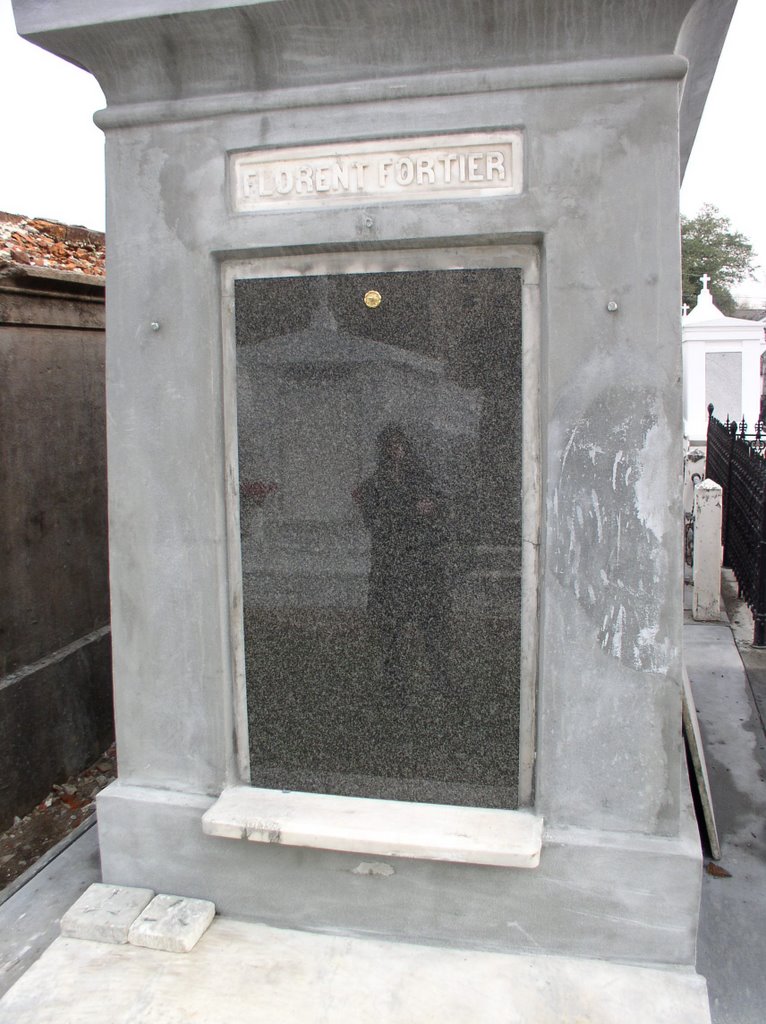
St. Louis Cemetery #2
New Orleans, January 2005


Brooklyn
September 11, 2006

Saturday, July 29, 2006

Freaky Friday

It was an ordinary Friday evening. It began innocently enough.

My wife was out in the kitchen, making her dinner. I was reading a magazine story in the bedroom.

End of the week. Relaxing. Nice.

Little did we know what the next few hours had in store for us.

The story, in last Sunday’s New York Times Magazine, was about the recent influx into America of quiet, slow-moving ghost movies from East Asia. The story itself wasn’t scary, merely informational and comprehensive in the manner of trend pieces written well after the trend has been recognized and popularized by millions the world over. But it reminded me of the Japanese spooks I’ve been watching more of lately, delving into this phenomenon known as “J-horror” (though some of its signal directors hail from China or Thailand). Some of the movies have been better than others, but the genre’s fundamental tropes remain intriguing to me: it appears in these early investigative stages that Asian horror and I are on roughly the same wavelength.

But last things first.


We were watching, along about 10:30 EST, a show on the Travel Channel called “Most Haunted.” It comes from the UK, and we’ve seen it several times before. Frankly it’s on the ripe side -- ripe as cheese is ripe. It doesn’t pretend to great scientific rigor, or even a convincing skepticism. Rather, it situates its crew of regulars (host, psychic, historian, camera crew, a few assistants) in an ancient castle or baronial mansion somewhere in the sceptered isle and leads the viewer on a touristy circuit of well-dusted rooms and velvet-roped-off antiquities. Each place has its ghost story, some legend pert and polished from years of being told, embellished, and retold by frustrated actors wearing beefeater costumes or Victorian bustles. Bluntly put, “Most Haunted” is for the tourists, and not for anyone who is interested in catching sight of something unaccountable. (You need “Ghost Hunters” on Sci-Fi for that.)

In the UK, “most haunted” must be synonymous with “least active.” Nothing happens on this show. Nothing, anyway, that can’t be explained by nature or human presence. A floorboard creaks. Yes. That happens, even in non-haunted domiciles. There’s a tap at the window. That also happens. Shadows. A flashlight fails. The rest is merely whooshing shock music, psychic Derek Acorah’s vaudeville trances, the occasional thrashing camera move, and some very overactive imaginations.

The main attraction of “Most Haunted,” at least for jaded postmodern hipsters like us, is not the ghost but the host. The host is Yvette Fielding, and Yvette Fielding is a woman on the edge. Either she is overacting strenuously -- admittedly a possibility, given her publicized background as a sitcom star and hostess of such BBC-TV faves as “What’s Up Doc?” and “Karaoke Challenge” -- or she is desperately neurotic. Never, in life or on the tube, have I seen anyone so susceptible to the influence of spooky stories or a dark room. Literally true: the instant the lights are switched off and the pea-green night-vision video comes on, Yvette turns into a quivering mass of inconsolable fear. Whether sitting in a chair waiting for a ghostly squeak or tiptoeing through a haunted boiler room, she spends every instant on the verge of explosive hysterics. If the cameraman moves, she gasps. (“Oh my God -- tell me it was you that just moved.”) If she bumps into a wall, she screams. (“Oh my God -- tell me that was the wall I just bumped into.”) If she hears a sound, she has a seizure. (“Oh my God -- tell me that was you that just belched.”)

Yvette had such a bad time in tonight’s location (a spirit-ridden brewery) that she abandoned her post, vowing tearfully that she wouldn’t enter that basement again. (Not essential anyway, since most of the show had been shot by that point.) We were beginning to wonder, watching Yvette’s lip quiver and her eyes melt like a puppy’s as it enters the euthanasia room, whether it was strictly ethical for the show’s producers to continue to place this unstable woman in such psychologically traumatic situations. But later I checked the website and found that “Most Haunted” is produced by the company Yvette founded with her husband.

She’s crazy, all right. Crazy like an executive producer.

Most of us have an inner heckler, and Yvette brought out ours tonight. But in some measure we may have been trying to laugh off our own, quite recent meetings with the unaccountable.

My wife had just told me about an eerie experience she’d had last Tuesday, while working at home. She was alone but for our cat. The apartment, she said, was silent: no stereo, radio, television, or other conduit of sound was active. The windows were closed against the heat wave that's been wilting our fair metropolis for more than a week now. So she was at her desk, absorbed by work, when she heard, she said, the sound of a human voice coming from the direction of the kitchen.

This apartment is a decent size by the New Yorker’s standards, but tiny by anyone else’s. Meaning that the kitchen is maybe 20 feet away from where our desks are. That’s close enough to remove much of the ambiguity around any perceived sound. Close enough, in other words, so that you know the sound didn’t seep through a brick wall, or several layers of floorboard and insulation.

My wife noted the sound and reflexively looked back toward the kitchen. Nothing there. She was vaguely unnerved. But soon enough she was back into her work.

It happened again.

This time she stopped and looked hard at the kitchen. I can picture my wife in my mind, staring over her shoulder. Waiting to hear the voice again. The same way I would. Or you, or anyone would. The way we all probably have, those times we’ve heard voices where no voices ought to have been heard.

Her gaze must have been withering in its focus, enough to deter even an envoy from beyond. The voice didn’t come again.

I quizzed her. What did the voice sound like? A man’s voice, I guess. What was it saying? You couldn’t make it out. How long did it talk -- was it a long sentence with several words like this one? Or short like this? More like the first one. An actual sentence.

I was a little creeped out,
my wife said. She’s a psychologist by training and profession. A scientist by nature, a rationalist by lineage. She isn’t creeped out that easily.

So that was another tile in our freaky Friday mosaic. Asian horror film article; voice in the kitchen; “Most Haunted” gimcrackery.

But the weirdest part of the evening came in between the first and the second.

I went to the kitchen to make a snack, leaving my wife in the bedroom, watching “The Soup” on the E! Channel (more jaded postmodern hipsterism for us). The cat came out behind me, wanting, as usual, to be fed first. I rushed around testily, wanting to get back into “The Soup” before the commercial break ended.

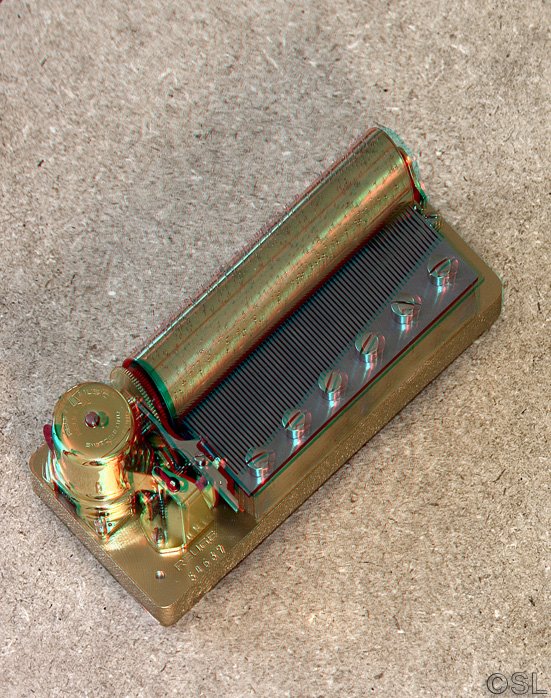
Quite suddenly, there came the sound of a music box from several feet away. No music box had played in our living room for years, if indeed ever. It was startling. Very crisp and loud for a music box, as if it were not only fresh from the craftsman’s workshop, but large enough to chime and vibrate like the tiniest of carillons.

My first thought was, do I recognize that song? Had the tiny wind-up mechanism that plays “Imagine" -- given me as a gift by my wife years ago -- somehow migrated from the back room to the living room? No, that wasn’t it: I’d never heard this song before.

My second thought, Asian ghost movies in my mind, was: this is like a scene in a scary movie. Music box music from nowhere. Twilight tinklings from the other side. Followed by -- what?

I tried to determine the source. Perched at the end of our fireplace mantle was, and is now, a small tin toy that my mother had sent me some time back: a fairground carousel. Could it be that? But it seemed that was merely a spinning toy; I certainly didn’t remember it having a music box built in. But that had to be it. My wife must have wound it, or cranked it, or whatever, some time earlier, and now it was playing in a sort of delayed response. A half-baked explanation at best, but sometimes the truth is half-baked: dull, doughy, unsatisfying, unexciting.


The music box, or carousel toy or whatever it was, completed its tune. I finished constructing my snack and hurried back to “The Soup.” My wife was laughing wildly at something and I was frantic to see what.

After the show, I went back to the living room and examined the tin carousel. Indeed, there was no music box component to it, merely a lever one pulled back and released, whereupon the carousel would spin rapidly, sending its riders flying out at near-perpendicularity to the centrifugal center. Ah! -- but nestled behind the carousel was something that had been there for years, long enough for its presence to have gone unremembered at first: a black wooden box, painted Japanese-style with brightly colored birds and drooping willows, containing inner compartments for the storage of jewelry. It was my wife’s, inherited from her mother, and long unused except as incidental decoration to the fireplace.

I opened wide the maw of the box. There, sure enough, in its bottom corner beneath a lift-out container, was something that looked like a stippled steel roll -- as in a music box. And on the underside of the larger box was a small handle for turning -- as with a music box. All came clear to me: my wife had, for some reason, earlier opened this jewelry box for the first time in years. She’d cranked the steel roll. Maybe it had played for her, maybe it hadn’t. But evidently it had come to unexpected life some time later, during my snack preparation. And that was the source of the music I’d heard.

Still not quite fully baked, this revised explanation, but nearer to fullness than before.

I cranked the handle and took the box to the bedroom to present to my wife. As a peculiarly rusty, dispirited tune clanged forth, I told her what had happened earlier: the sudden springing into play of an unidentifiable music box tune. It must have been this! I said; I’d forgotten all about this. It is a music box, after all, and it was in the exact area I heard the music coming from.

Her eyebrows went up, then down. She assured me she hadn’t touched the box in years, and in any case hadn’t felt compelled to twist its musical crank since childhood. How did it simply begin playing by itself? Out of nowhere, utterly crankless? I assured her in turn that I had heard a music box and that it had to have been this one -- even though I now realized what a thick coat of dust the box bore, indicating its long neglect by human hands, and was troubled by the utter dissimilarity of its damp and joyless donging to the clear, ringing tones I’d been startled by earlier.

No. This had to be the source of that mysterious music. Didn’t it?

The box thudded dustily in my hand.

My wife and I stared at each other. She said it was really, really weird. I said something to the effect that maybe her mother -- a physicist and the single most intractably rational person I’ve ever met -- could explain the whole thing sensibly, with perfect scientific satisfaction to all.

Then my wife told me for the first time about the voice she believed she’d heard in the kitchen a few days ago. I remembered those Asian ghosts, blurry and blinking on staircases and at the ends of hallways, here this instant, gone the next. And before long we were laughing at Yvette Fielding’s quivering lip and credulous openness to every hypothetical spook in the universe.

It seems the obvious answer to the music box conundrum: the box did, somehow, begin playing by itself, by some natural or preternatural incidence of spontaneous energy, and I just happened to be there to hear the result.

Hmm. Wish I could buy that. But I remain -- to invert the standard disclaimer -- skeptical of the rational.

Just another freaky Friday.

Monday, July 03, 2006

Human Sacrifice in Mayfair

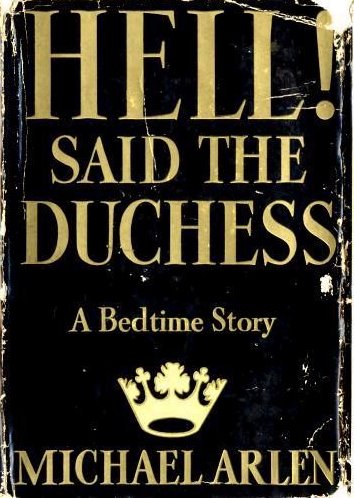
Funny, the fakeries a literary artisan can work on even an experienced reader. Michael Arlen has just done it to me. His Hell! Said the Duchess: A Bedtime Story -- remarkable title -- is in most ways a routine work of its time (1934), place (green fields of the popular English novel), and genre (the fanciful crime-and-detection narrative). It may even deserve its obscurity. But it's remarkable for being, for most of its length, a piece of well-stitched frippery, smooth to the touch and dozy on the brain, which turns, when least expected, into something more louche and lascivious, something that more than hints at extreme depravity.

Michael Arlen is an interesting writer ripe for rediscovery. I came across him recently while reading Fitzgerald's Tender is the Night, in which he was name-checked as an avatar of the 1920s and the Jazz Age mentality -- as if Fitzgerald himself hadn't been acclaimed as avatar above all. I knew Arlen's son was Michael J. Arlen, once a brilliant television critic for The New Yorker, as well as author of Passage to Ararat, a memoir on his reclamation of Armenian roots. He'd also written a memoir of his father, Exiles, and it had told the story of an Armenian who moved to England as a young man and was so taken with the country, its culture and manners, that he Anglicized himself in every conceivable way, from language to name to tastes. The only thing he didn't take on, apparently, was English snobbery: the certainty that class determines destiny.

Arlen's great success, The Green Hat (1924), was something of an English equivalent to The Great Gatsby (despite being published a year earlier) in summing up its flappers-and-philosophers moment, even as that moment was playing out. Numerous short stories and a successful West End production of The Green Hat starring Tallulah Bankhead cemented Arlen's notoriety as a generational observer. His foreignness was an open secret and nothing Arlen hid away; yet he came, much like T.S. Eliot or V.S. Naipaul, to be adopted as a more or less honorary Englishman. Unfortunately his career dwindled in a run of pop novels, failed plays, and minor essayistic work; finally a devouring case of writer's block prevented him from producing a word for several years before his death in 1956.

Anyway: Hell! Said the Duchess. Young men are turning up dead in London, their bodies naked and debauched, their throats deeply slashed. Evidence points to a female culprit (soon dubbed "Jane the Ripper"), and the likeliest, albeit least expected suspect is the virtuous Mary Dove, Duchess of Dove and Oldham, young society widow. Those on all sides of Mary -- fair-weather friends, opportunistic politicos, flummoxed CID men -- wonder how this model of respectable upper-class English womanhood could be the perpetrator of such ghastly crimes; when she is spied leaving her Grosvenor Square townhouse late at night for parts and deeds unknown, they begin to wonder how it could not be her.

The novel chugs, motors, tootles along. Margins and typeface are quite large. Pages fly past. It's all very funny and just barely diverting from the cares of the day: that's all popular fiction has to be. The fleet and modest narrative is clued in to the class life of Mayfair, and full of those tasty rhetorical turns once minted by Wilde and Chesterton, observations of duplicitous humanity which are both undeniably brilliant and a mark of the minor sensibility, no matter their truth.

Then there is a quite extraordinary scene. I give nothing away to say that it involves two detectives knocking on the door of a shady foreign man; that his tart phrasing of plain truths disarms the dicks; and that he is seen to be wearing, for some reason, a salmon-colored, shoulder-strapped lady's swimming garment.

Hmm, is the thought, now there's a wrinkle. Soon the climax winds into view and the wrinkle becomes a crevice. The novel turns irrevocably from being a piddling, polite procession of manners into something hell-fired. The man who has become our hero is plunged into a nightmarish little scene whose possibilities could not have been presaged but whose logic makes good enough sense, in addition to being surprising, frightening. The wrought-iron gates of Grosvenor Square are burned red and twisted into the gates of hell, and beyond those gates lies an ending with some small and troubling ingredient of tragedy. The last paragraph is terse, free of pity.

What has Arlen been up to all this time? Quite certainly, more than you imagined he was at the start. But has it been a joke? Or merely the set-up for a joke that never came? Is this the punchline? Why am I not laughing?

I may not be haunted long by this silly tale with its preposterous denouement. But I'm haunted today. And today has several hours left in it.


The Grenadier Pub, Wilton Row, Belgravia, London, June 29, 2006
"Cedric"